It was a fantastic experience to be the 2025 Novel Fair judge alongside Declan Burke, Roe McDermott, John Patrick McHugh, and Lia Mills. I was familiar with the work of most of these writers, but had never met any of them in person before.
Over 120 extracts of 10,000 words, each with a 1-page synopsis. Six weeks to read them and whittle down to a short list of twelve. That was basically all the instructions. We were given free reign and told not to take into account the sales potential of the novel, nor Irish-relatedness, nor whether we should aim for a spread over genres. Just use our own judgement.
My own tastes can be deduced from my blog and the many reviews I’ve done. I like fiction that confronts the way the world has ceased to be a reasonable place and all is in flux. I’m sort of an antipode to the sentiment: “wasn’t it ever thus?”
Before I began I had an expectation – a hope even – that a certain proportion of entries might spontaneously self-select for the reject bin. I mean that within a couple of paragraphs it would become blatantly obvious that this was not up to publishable standard. It was not an unreasonable expectation; I’d chosen fiction for lit magazines before.
But with almost all of the entries I had to read to the last sentence of the 10,000 words. No shortcuts. They had generally been edited to a very high standard. That’s not a bad thing, but good editing is something that can be bought. I always kept that in mind to repress the mini grammar nazi within. When you get used to a certain industry-standard smoothness of prose it can prejudice you against a text that, for example, uses the word lightening instead of lightning. But a writer who has not studied a humanities subject at college might regard such details as superficial as the wrong font choice. (In some places that too can get a submission thrown in the bin.)
One hundred and twenty extracts. I got used to reading six a day. I initially labelled 31 of them to be read again. Then whittled that down to twenty-odd. It was tough making decisions after that. I find it hard to judge prose in a genre outside what I generally read. There were also some written in a cerebral style of prose, Banville style, that took some time to warm to. When you are grinding your way through thousands of pages of text, you can feel a superficial attraction to lightweight clear-running prose.
And then there were a few provocative novels: druggie escapades, cynicism, explicit sex, someone angry at the world, sceptical of sjw’s. That’s all fine by me; I’m a little bit biased toward such novels.
One extract featured a distinctly unlikeable young woman who juggles a number of fake social media profiles (often with images of blondes), sexting with men, then she has sarcastic thoughts about her social justice friends, all shot through with Diogenean-level misanthropy. The psychological portrait of the main narrator fascinated me, and it was a big plus (as a novel) that it was all set in modern Dublin, complete with Luas trips, boring office work, a woman thinking frankly about sex, and the escape into social media. I had the unavoidable but ultimately futile thought, “I wonder how much of the writer is this character.”
The author’s name was revealed when the final list was agreed. Ciara Broderick. The announcement of the sale of her novel was made last week, acquired by 4th Estate “in a nine-way auction” whatever the hell that means.


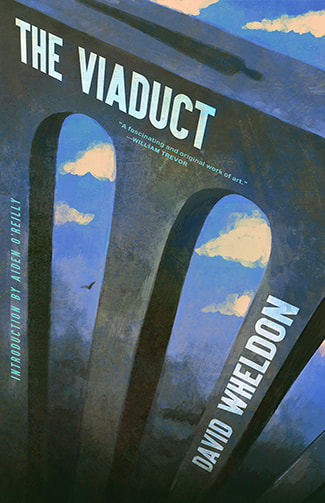
Valancourt The Viaduct reissue
.
Irish Times Q+A